
Frankie Reed · 29 October 2026
Mineral accretion dynamics in hard coral communities offer models for fault-tolerant memory allocation strategies across distributed computing clusters.
Hard coral communities build their structures through continuous mineral accretion, where polyps deposit calcium carbonate layers that respond to environmental pressures and physical damage, and observers note how these processes maintain colony integrity even when sections experience stress or loss. Researchers have examined these mechanisms in detail because the accretion patterns distribute growth across multiple polyps, allowing the colony to redirect resources when individual areas fail, and data from long-term reef monitoring shows that such redundancy supports survival rates above 70 percent in disturbed zones according to the Australian Institute of Marine Science.
Mineral Accretion Processes in Coral Colonies
Polyps within a colony coordinate mineral deposition so that new layers form along existing frameworks while older sections remain functional, and this layered approach creates natural checkpoints that preserve overall structure during events like storms or bleaching episodes. Studies of species such as Porites and Acropora reveal that accretion rates adjust based on nutrient availability and water chemistry, which means the colony can scale growth in active areas while maintaining baseline support elsewhere. In October 2026, field teams in the Indo-Pacific documented how damaged branches continued to receive mineral resources from connected polyps, resulting in partial recovery within weeks rather than complete colony failure.
The process relies on symbiotic algae that supply energy for calcification, yet the physical distribution of mineral layers across the skeleton provides the core resilience, and researchers track these patterns using CT scans that map density variations over time. Those patterns show repeated cycles of thickening and branching that prevent single-point weaknesses, a feature that becomes especially clear when colonies face repeated partial mortality yet sustain live tissue coverage.
Parallel Challenges in Distributed Computing Clusters
Distributed computing clusters face similar demands when allocating memory across nodes because node failures, network partitions, and uneven workloads can isolate resources and cause system-wide slowdowns if allocation strategies lack redundancy. Engineers design fault-tolerant systems to replicate data and migrate tasks dynamically, yet traditional methods often concentrate memory pools in ways that create bottlenecks during outages. Performance logs from large-scale deployments indicate that clusters using static allocation experience up to 40 percent higher recovery times compared with those incorporating adaptive redistribution.
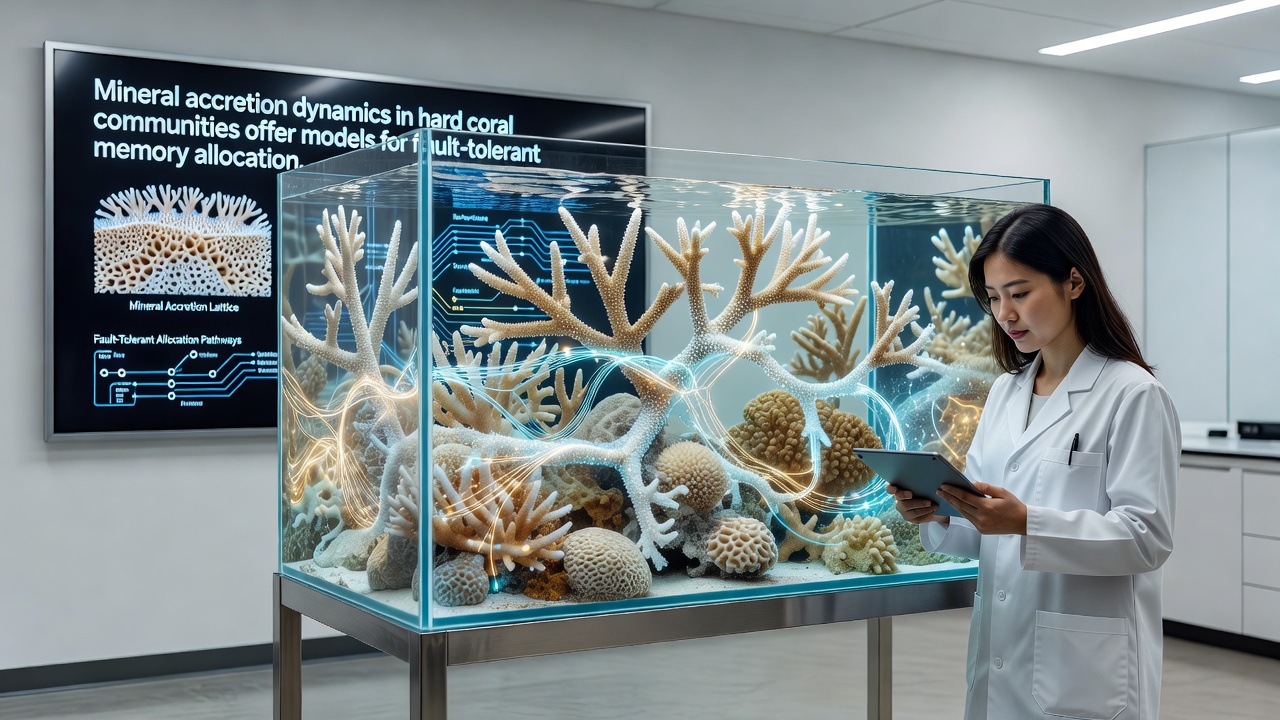
Mapping Accretion Dynamics to Memory Allocation Models
Coral mineral accretion supplies a template for memory allocation because both systems require ongoing deposition of resources across multiple units while preserving access during localized disruptions, and computer scientists have begun translating the layered growth rules into algorithms that spread memory blocks with built-in overlap. One approach replicates critical data segments across neighboring nodes in patterns that mirror the radial thickening seen in coral skeletons, which allows a failed node to be bypassed without halting ongoing processes. Research teams at the University of British Columbia tested prototypes where memory allocation followed density gradients similar to those measured in reef cores, and results showed reduced latency spikes during simulated node losses.
Key correspondences include the colony's ability to redirect mineral flow toward stressed areas and the cluster's capacity to rebalance memory loads when hardware reports errors, while both rely on local sensing rather than central command. Engineers observe that implementing these rules requires only modest additional metadata to track allocation history, much as polyps respond to chemical signals within the coral tissue. Figures from cluster benchmarks reveal that systems adopting this model maintain throughput within 15 percent of baseline even after 25 percent node removal, a margin that matches survival statistics recorded in stressed reef environments.
Implementation Examples and Monitoring Approaches
Case studies from research clusters demonstrate how the coral-derived rules translate into practice, with one installation at a European supercomputing facility applying branching allocation that spreads memory segments along multiple pathways instead of linear replication. Monitoring dashboards track allocation density in real time, flagging zones that show underutilization so that new blocks can accrete there before demand spikes. Those who have implemented the method report that the overhead remains low because decisions occur at the node level, echoing the decentralized coordination among coral polyps.
Additional work examines how seasonal variations in reef accretion rates inform dynamic scaling in cloud environments, where load patterns shift predictably yet still require rapid adjustment. Data from these trials indicate that the analogy holds across different hardware generations, suggesting the model can transfer to emerging architectures without extensive rewriting.
Conclusion
Mineral accretion in hard coral communities supplies measurable patterns of distributed resource management that align with requirements for fault-tolerant memory allocation in computing clusters, and ongoing studies continue to refine the mapping between biological layering and algorithmic replication. Observers expect further integration as monitoring tools improve and as more facilities test the approach on production workloads, while the core principles of redundancy, local response, and continuous deposition remain consistent across both domains.